Blog
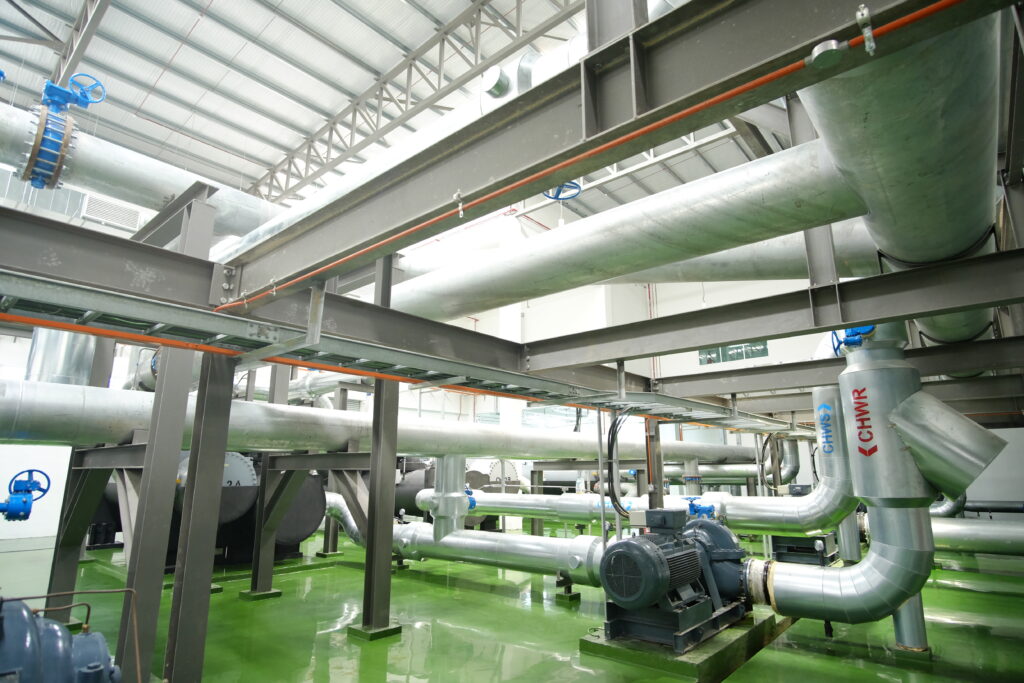
Chiller plants play an important role in maintaining indoor comfort and supporting operations in commercial buildings, hotels and industrial facilities across Singapore.
Over time, equipment ages, maintenance requirements increase and operating performance may deteriorate. Rising electricity costs can add further pressure on building operating budgets.
For building owners and facilities managers, deciding whether to retrofit an existing chiller plant or replace it entirely is an important investment decision. Upgrading too early may result in unnecessary expenditure, while delaying essential improvements can increase operating costs and the risk of equipment failure.
The right decision depends on the plant’s condition, energy performance, cooling requirements and remaining service life.
This guide outlines five signs that your chiller plant may need attention and the factors to consider before committing to an upgrade.
Energy consumption is one of the most useful indicators when assessing chiller plant performance.
If electricity consumption is increasing despite similar cooling demand and operating hours, the plant may no longer be operating efficiently. Possible causes include equipment deterioration, poor control settings, fouled heat exchangers, inefficient pumps or cooling towers, and changes in system operation.
However, higher energy consumption does not automatically mean the chiller needs replacing. The underlying cause should be identified first.
Building owners should review the following:
• Historical electricity consumption and cooling demand.
• Chiller efficiency under actual operating conditions.
• Pump and cooling tower performance.
• Operating schedules and control sequences.
• Maintenance records and equipment condition.
When appropriate, a plant energy assessment can establish a performance baseline and identify improvement opportunities. Depending on the findings, adjustments to controls, maintenance or selected components may improve performance without requiring a complete replacement.
Ageing equipment may require more frequent repairs, replacement parts and specialist servicing. Recurring breakdowns can also affect building operations and occupant comfort.
When assessing maintenance costs, building owners should look beyond individual repair invoices.
Review equipment failure frequency, spare-part availability, the time required to restore operation, and the cost of maintaining ageing components.
Consider these warning signs:
• Repeated faults affecting the same equipment.
• Increasing expenditure on major repairs.
• Obsolete components or limited spare parts availability.
• Longer equipment downtime.
• Difficulty maintaining stable cooling performance.
If these issues persist, replacing selected equipment or undertaking a wider plant retrofit may be more practical than continuing with repeated repairs. The decision should consider the cost of maintaining the existing system against the investment and operating costs of the proposed upgrade.
A chiller plant should match the facility’s cooling requirements.
Changes in building occupancy, operating hours, tenant mix or industrial processes can affect cooling demand. An existing system may be oversized, undersized or poorly configured for current operating conditions.
An oversized plant may operate inefficiently at low loads if its equipment and controls are not suited to the demand profile. An undersized plant may struggle to meet peak cooling requirements.
Before upgrading, assess the following:
This assessment helps determine whether the best solution is a control upgrade, equipment replacement, capacity adjustment or broader system redesign.
Equipment age is an important consideration, but it should not be the only reason to replace a chiller plant.
The remaining useful life depends on equipment condition, operating history, maintenance quality, component availability and the cost of continued operation.
A plant may remain serviceable beyond its expected design life, while another may require intervention earlier because of poor condition or changing operational needs.
Building owners should assess the following:
• Manufacturer recommendations and equipment condition.
• Maintenance and repair history.
• Refrigerant and component availability.
• Reliability requirements and redundancy.
• Expected replacement costs and future operating expenditure.
A condition assessment can help establish whether the equipment should continue operating, undergo a targeted retrofit or be replaced.
Planning ahead also gives building owners more time to evaluate financing options, coordinate installation works and minimise disruption to tenants or business operations.
Older chiller plants may have limited monitoring capabilities or controls that do not respond effectively to changing cooling demand.
Without reliable operating data, facilities teams may find it difficult to identify inefficiencies, detect abnormal conditions or determine whether an upgrade has delivered the expected results.
Modern control and monitoring systems can provide greater visibility into plant performance, depending on the equipment and system integration.
Useful measurements may include:
• Chiller electricity consumption and cooling output.
• Chilled water supply and return temperatures.
• Water flow rates and system differential pressure.
• Chiller loading and operating hours.
• Pump and cooling tower performance.
• Equipment alarms and operating trends.
Monitoring data can help facilities teams identify performance issues and make better-informed operational decisions.
For older plants, upgrading controls and monitoring may be worthwhile even when the main chillers remain in serviceable condition.
Once the existing plant has been assessed, the next step is to compare the available options.
A retrofit focuses on improving selected equipment or system components. Replacement involves installing new equipment, which may include redesigning the wider cooling system.
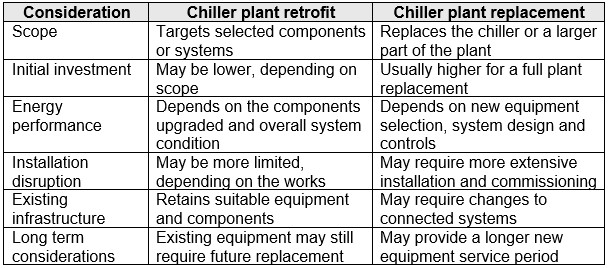
Neither option is automatically better.
A retrofit may be appropriate when the existing plant remains in reasonable condition and specific improvements can address the main performance issues.
Replacement may be more suitable when major components are deteriorating, the system no longer meets cooling demand or a retrofit cannot achieve the required performance.
The final decision should be based on a technical assessment and a comparison of whole-life costs.
The financial assessment should cover more than the initial equipment price.
Building owners should compare the cost of continuing to operate the existing plant with the expected costs and benefits of the proposed upgrade.
Key considerations include:
Account for planned servicing, corrective maintenance, spare parts and potential major repairs.
Assess the expected operating period of the proposed equipment and the remaining life of existing components.
A reliable assessment should state its assumptions and account for changes in energy tariffs, cooling demand and operating hours. This gives building owners a more complete basis for comparing upgrade options.
For some building owners, the main barrier to a chiller plant upgrade is not the technical solution but the upfront capital required.
Cooling as a Service (CaaS) offers an alternative commercial model. Depending on the agreement, a service provider may finance, design, install, operate and maintain the cooling plant under a long term service arrangement.
This can reduce or remove the need for the customer to fund the entire plant investment upfront.
Before considering CaaS, building owners should evaluate the service fees, contract duration, equipment ownership, maintenance responsibilities, performance commitments and termination provisions.
The commercial arrangement should also reflect the facility’s cooling requirements and expected period of use.
For organisations planning a substantial retrofit or replacement, CaaS may provide another way to assess the technical and financial feasibility of the project.
KJCyclect provides cooling solutions that address chiller plant infrastructure, operation and ongoing performance management.
For building owners considering an upgrade, the starting point is to understand the existing plant’s condition, cooling demand, energy consumption and operational requirements.
Based on the project requirements, potential solutions may include chiller plant upgrades, equipment replacement, system optimisation and Cooling as a Service.
Where CaaS is suitable, the agreed commercial model can combine cooling infrastructure delivery with ongoing operation and maintenance, potentially reducing the customer’s upfront capital requirements.
Each project requires an assessment of technical feasibility, expected performance and commercial terms before the appropriate solution can be established.
A chiller plant upgrade should address the underlying issues affecting performance, reliability and operating costs.
Increasing energy consumption, recurring equipment failures, changing cooling demand and limited monitoring capabilities can all indicate that an assessment is needed. However, the right response may range from targeted improvements to a complete plant replacement.
By reviewing the system’s condition and comparing whole-life costs, building owners can make a more informed investment decision.

KJ Cyclect Pte Ltd
UEN: 202515785E