Blog
Cooling is a major operational consideration for commercial buildings, hotels and industrial facilities in Singapore. As cooling systems age, building owners must balance the cost of equipment upgrades with energy efficiency, operational reliability and long-term maintenance.
Traditional chiller plant procurement requires businesses to plan for equipment, installation and ongoing operating costs. For organisations with competing capital priorities, this can delay essential upgrades.
Cooling as a Service (CaaS) offers an alternative. Under this model, a service provider can fund, install, operate and optimise the cooling system under an agreed commercial arrangement. This can reduce or remove the need for upfront capital expenditure by the customer.
However, avoiding a large upfront investment is only one consideration. Building owners should evaluate the technical, financial and operational implications before committing to a long-term cooling service agreement.
Here are five factors to consider when assessing whether CaaS is suitable for your facility.
A chiller plant upgrade can involve significant expenditure on equipment, engineering, installation, commissioning and associated infrastructure.
Under a traditional procurement model, the building owner generally funds the project directly or arranges separate financing. With CaaS, the service provider may fund the investment and recover the cost through an agreed service payment structure.
This can help businesses manage capital allocation while addressing cooling infrastructure needs.
Before selecting a model, building owners should evaluate the following.
A zero upfront CAPEX arrangement does not mean the cooling service has no cost. Businesses should compare the total financial commitment over the contract period and assess how it fits their operational budget.
Not every ageing chiller plant requires complete replacement. In some facilities, targeted improvements to controls, pumps, cooling towers or operating sequences may deliver worthwhile efficiency gains.
A proper assessment should establish how the existing system performs under actual operating conditions.
Key areas to evaluate include the following.
Review electricity consumption against cooling demand and operating hours. This helps establish the existing energy performance baseline.
Assess chiller age, maintenance history, recurring faults and the availability of replacement parts.
Understand current cooling loads, peak demand and expected changes in occupancy or production requirements.
Review the interaction between chillers, pumps, cooling towers, controls and distribution systems. The performance of the overall plant matters, not just the efficiency of individual chillers.
These findings help determine whether a targeted retrofit, equipment replacement or broader system upgrade is appropriate.
For a CaaS proposal, the assessment should also establish how the proposed improvements will be measured and verified.
Cooling plant performance depends on more than the initial installation. Equipment must be maintained, operating conditions monitored and system performance reviewed throughout its service life.
A CaaS agreement may combine engineering delivery, operation, maintenance and remote monitoring under one service arrangement.
For building owners, this can simplify coordination between multiple service providers. However, the precise scope and service commitments must be established before signing the agreement.
Consider the following questions.
These details matter because a cooling system must support the facility’s operating requirements. A hotel, commercial office and industrial facility may have different expectations for operating hours, redundancy and service response.
The contract should define the responsibilities of both parties and the process for addressing performance shortfalls.
The initial purchase price does not represent the full cost of operating a cooling plant.
Over its service life, the facility will incur electricity, maintenance, repair and eventual replacement costs. These should be considered when comparing traditional procurement with CaaS.
A whole life cost assessment should include the following.
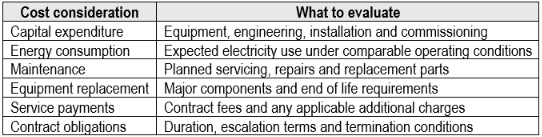
Where energy savings are projected, the assumptions should be transparent. The assessment should account for cooling demand, operating hours, energy tariffs and changes in building use.
Building owners should also check how savings will be measured against the baseline and how changes in operating conditions will be treated.
The objective is to understand the total financial commitment and expected operational outcomes, rather than making a decision based on a single cost figure.
CaaS may be worth considering when a building needs a substantial cooling upgrade but wishes to manage upfront capital requirements.
It may also suit organisations seeking an integrated arrangement for cooling plant delivery, operation and maintenance.
Potential applications include commercial office buildings, hotels and industrial facilities. Suitability depends on the existing infrastructure, cooling demand, project economics and operational requirements.
Before proceeding, building owners should consider the following:
Is the plant approaching the end of its useful life, or can targeted improvements address the current issues?
Does the expected duration of building use support the proposed service contract?
Can the existing plant be upgraded, or is a new system required?
Are the service fees, responsibilities, performance requirements and contract terms appropriate for the business?
Can the upgrade and commissioning works be planned around the facility’s operational requirements?
A technical and commercial assessment can help determine whether CaaS offers a suitable route for the project.
For Singapore building owners, CaaS provides an alternative to traditional equipment procurement. It can help address capital constraints while bringing cooling infrastructure, maintenance and performance management into an integrated service arrangement.
The right approach starts with understanding the existing system, establishing an energy performance baseline and comparing the technical and commercial options available.

KJ Cyclect Pte Ltd
UEN: 202515785E