Centralised Cooling. Efficient by Design.
Chilled water from a central cooling plant, distributed to multiple buildings within a defined development — planned, engineered, delivered, operated and maintained by KJCyclect.
A District Cooling System consists of a central cooling plant that produces chilled water and distributes it through a network to connected buildings.
Each building receives chilled water through a dedicated connection. The building uses the chilled water to provide air conditioning and cooling for its internal systems.
The central plant manages cooling production while the connected buildings receive cooling as a service.
This approach can be suitable for large developments with multiple buildings and a sufficiently concentrated cooling demand.
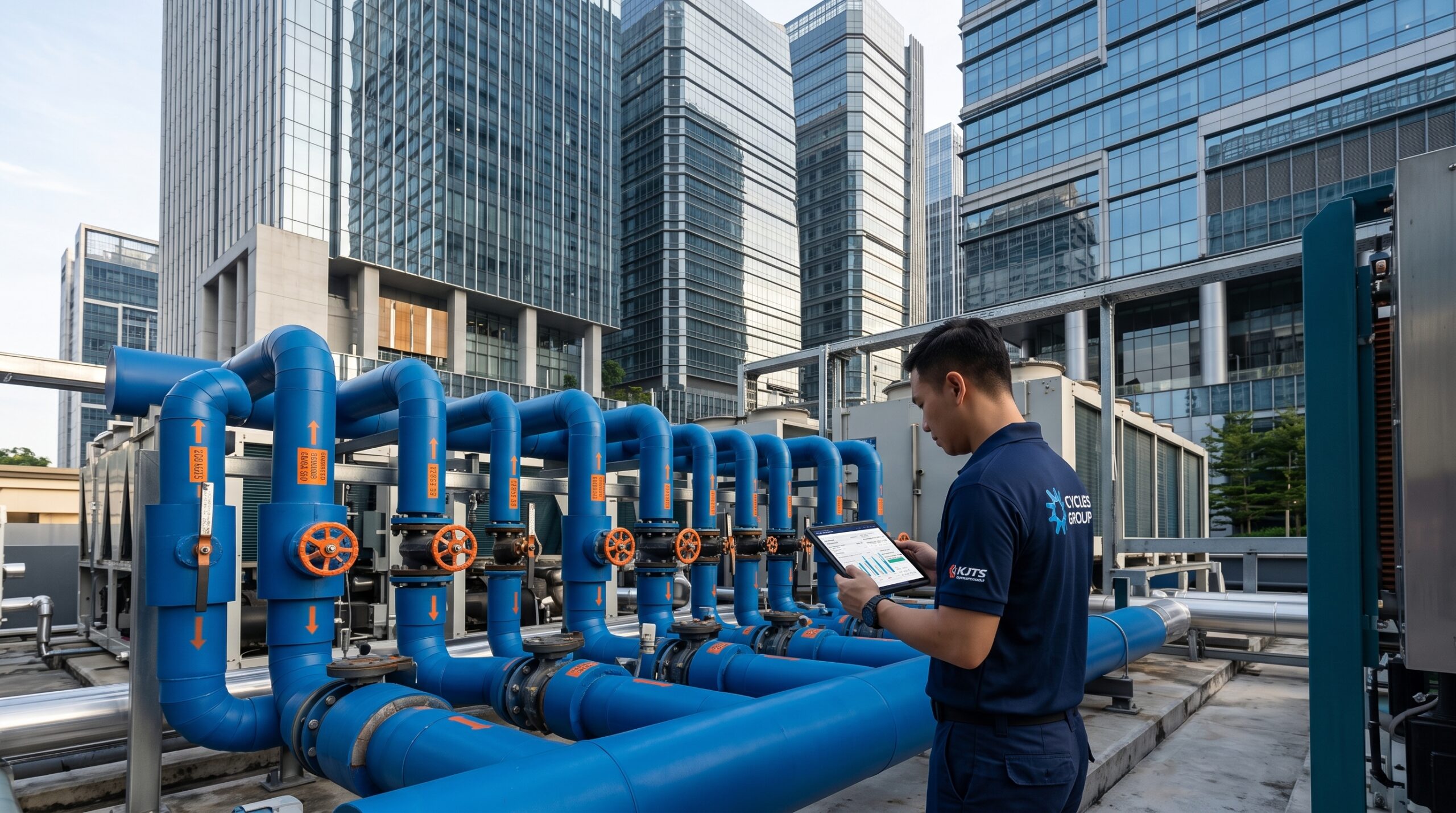
From chilled water production at the central plant, through the distribution network, to cooling delivered inside each connected building — and back again.
Chillers and associated equipment produce chilled water at a central plant.
Chilled water is circulated through an underground distribution network to connected buildings.
Each building receives chilled water through a dedicated energy transfer station or connection point.
The chilled water is used by the building's internal air conditioning system to provide the required cooling.
Warmer return water flows back to the central plant where it is cooled again and recirculated through the system.
Five stages, one integrated service. Each stage is managed by KJCyclect, with the client involved at the decision points that matter.
Cooling production is consolidated into a central plant rather than requiring separate cooling plants for individual buildings.
Centralised cooling allows plant operation to be managed around overall cooling demand across the connected development.
The system can be designed to accommodate multiple buildings and future connections, subject to the development's requirements and available capacity.
Connected buildings can receive chilled water without managing their own central cooling plant.
The central cooling infrastructure can be operated and maintained by a specialist cooling energy services provider.
CaaS is not a one-size-fits-all model. It works particularly well where cooling is significant, long term and worth managing as a specialist service.
KJCyclect considers plant efficiency, distribution performance, cooling demand, operating conditions and control strategies when developing district cooling solutions.
Improving how the plant operates across the connected development to support efficient cooling delivery.
Enhancing control strategies to align cooling delivery with actual demand across connected buildings.
Where technically suitable, upgrading equipment to improve overall system efficiency.
Where technically suitable, these measures support improved cooling efficiency and operational performance.
Cooling systems reject heat as part of the refrigeration process. Instead of treating this heat solely as waste, KJCyclect can assess opportunities to recover and reuse it where the facility has a suitable heating or hot water demand
Recovered heat reused for domestic hot water demand.
Recovered heat reused for process hot water requirements.
Recovered heat applied to preheating applications.
Other suitable thermal applications where demand exists.
The feasibility of heat recovery depends on the temperature requirements, cooling load, operating profile and existing infrastructure of the facility.
District cooling is a long term infrastructure asset.
KJCyclect supports clients beyond the initial project delivery by providing ongoing operation, maintenance, monitoring and optimisation.
Our objective is to help developments establish cooling infrastructure that is technically appropriate, operationally manageable and aligned with long term energy performance.
Email us or send your facility details and we'll come back with an honest assessment of where the performance gains are.

KJ Cyclect Pte Ltd
UEN: 202515785E